Andreas Burger

I am a CS PhD student at the University of Toronto with Prof. Alán Aspuru-Guzik.

I am interested in simulating (sub-)atomic scales. Currently with Machine Learning, previously with Quantum Computing and Tensor Networks. Fascinated by sampling.

Some of the themes I am thinking about:
Simulation by sampling from generative models.


News

07/2026: We will present MōLe and MōLe-Λ at ICML 2026 in Seoul

01/2026: I am starting my PhD Research Internship at NVIDIA

12/2025: HIP got selected as Spotlight at EurIPS SimBioChem

10/2025: Find me presenting HIP at MoML @ MIT

04/2025: DEQ Force Fields got selected as Oral Spotlight at ICLR AI4Materials

01/2025: I am at DTU Copenhagen visiting with Tejs Vegge at CAPeX

12/2024: DEQ Force Fields got awarded best paper at the Ellis ML4Molecules

Publications

MōLe-Λ architecture

MōLe-Λ: Learning the Coupled-Cluster Response State for Energies, Gradients, and Properties

ICML 2026 AI4Physics; MōLe at ICML 2026
Andreas Burger, Luca Thiede, Abdulrahman Aldossary, Jorge Arturo Campos-Gonzalez-Angulo, Alexander Zook, Jérôme Florian Gonthier, Alán Aspuru-Guzik

Molecular Orbital Learning (MōLe) is an equivariant model that predicts coupled-cluster excitation amplitudes from Hartree-Fock molecular orbitals. We showed strong data efficiency and out-of-distribution generalization to larger molecules and off-equilibrium geometries. MōLe-Λ extends this to the full CCSD response state by jointly predicting right-hand T and left-hand Λ amplitudes. The model yields CC-quality energies and forces while recovering dipoles, polarizabilities, electron densities, and pair densities over two orders of magnitude faster than full CCSD.

Derivative Informed XC-Loss

Derivative Informed Learning of Exchange-Correlation Functionals

ICML 2026
Eike Eberhard, Luca Thiede, Abdulrahman Aldossary, Andreas Burger, Nicholas Gao, Vignesh C Bhethanabotla, Alán Aspuru-Guzik, Stephan Günnemann

We introduce DI-Loss, which supervises first- and second-order energy derivatives on the Grassmannian of density matrices when distilling hybrid functionals into cheaper ML-XC models. Across four architectures, total-energy MAE drops by 66% on average, SCF warm-starts cut hybrid iterations by up to 55%, and excited-state predictions improve in downstream TDDFT.

HIP architecture

HIP: Hessian Interatomic Potentials without derivatives

EurIPS 2025 SimBioChem Spotlight
Andreas Burger, Luca Thiede, Nikolaj Rønne, Nandita Vijaykumar, Tejs Vegge, Arghya Bhowmik, Alán Aspuru-Guzik

We show how Hessians can be predicted directly with MLIPs, without relying on automatic differentiation or finite differences. HIP builds symmetric, SE(3)-equivariant Hessians from irrep features in the GNN message-passing. This makes HIP Hessians one to two orders of magnitude faster, more accurate, more memory efficient, easier to train, and improves scaling with system size.

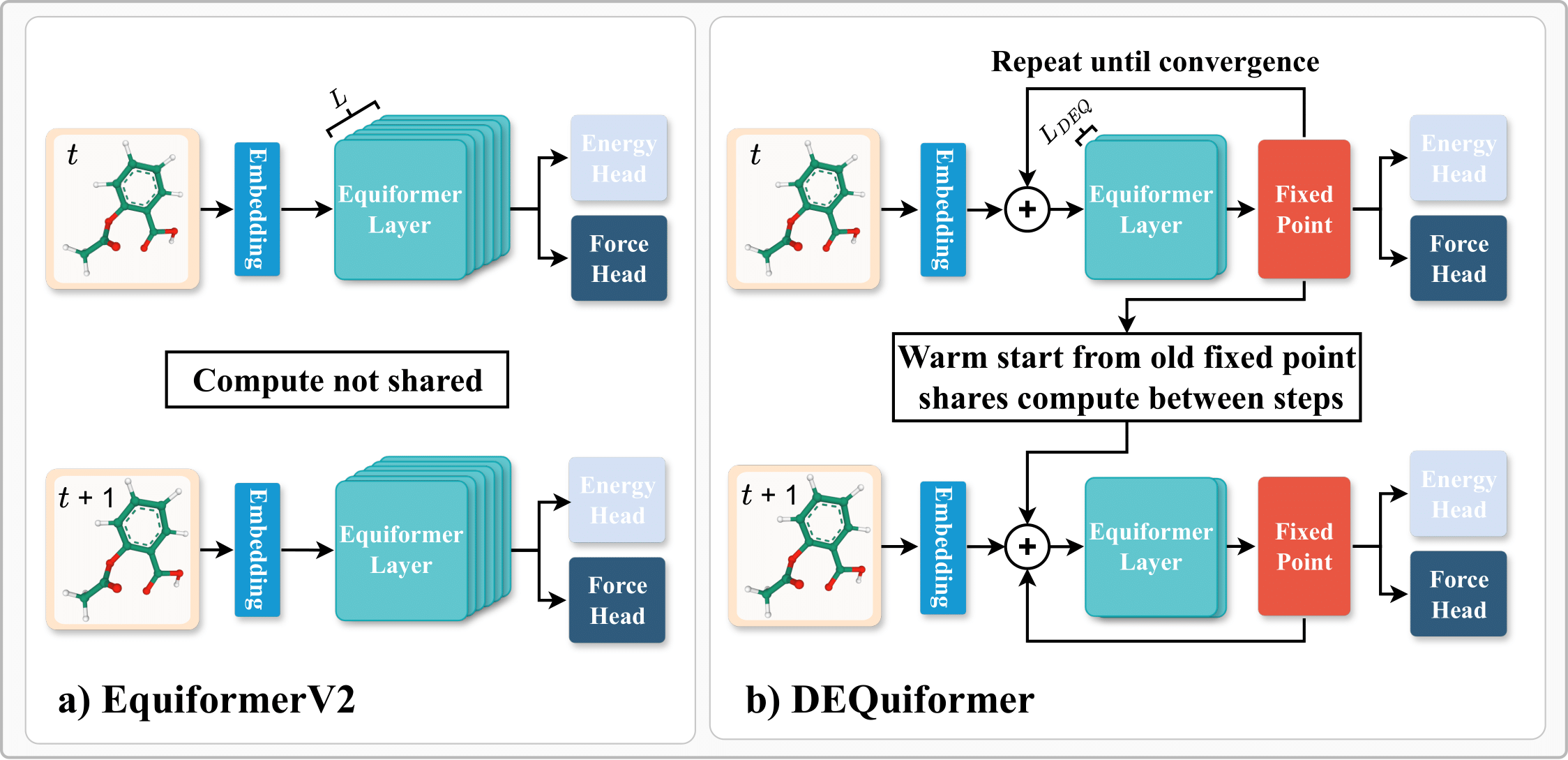
DEQ architecture

DEQuify your force field: Towards efficient simulations using deep equilibrium models

ICLR AI4Materials Spotlight, Ellis ML4Molecules Best Paper Award
Andreas Burger, Luca Thiede, Alán Aspuru-Guzik, Nandita Vijaykumar

We speed up molcular dynamics simulations by focusing the temporal structure of the problem. We reuse intermediate latents from the previous prediction step, by turning a state of the art architecture into a deep equilibrium model. Our method is faster, more accurate, and uses fewer parameters than the original model.

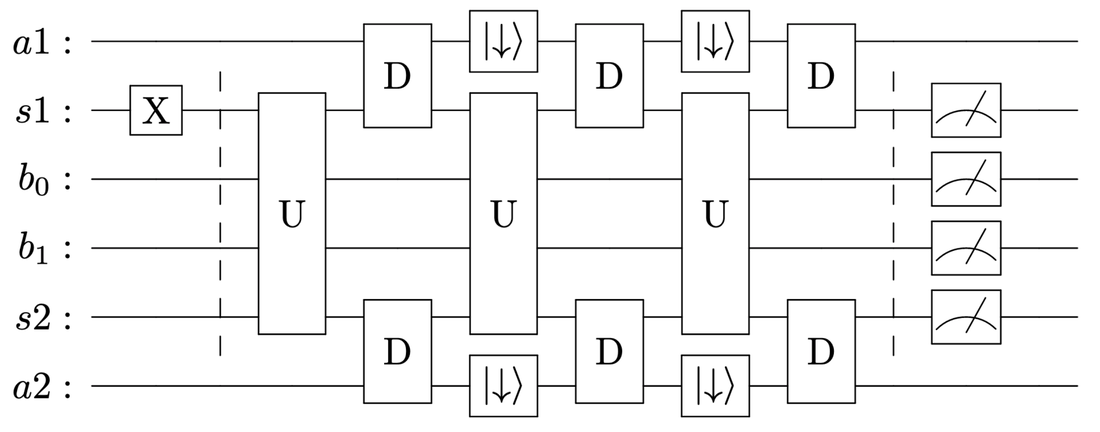
Spin Boson Model

Digital Quantum Simulation of the Spin-Boson Model under Markovian Open-System Dynamics

Entropy 2022, Special Issue Advances in Quantum Computing
Andreas Burger, Leong Chuan Kwek, Dario Poletti

We study how to simulate open quantum systems on near-term quantum computers. We combine trotterization for the closed hamiltonian part with "collisions" on ancilla qubits for the open dynamics.

Experience

PhD Research Intern

NVIDIA

2026/01 - 2027/01


Quantum Algorithm Engineer

IQM Quantum Computers

2023/05 - 2023/08


Consultant

EFS Consulting

2021/10 - 2021/12


Civil Service

Red Cross

2017/01 - 2017/09


Construction

Fruit Security

2014/07 - 2014/07

Education

PhD Computer Science

University of Toronto

Prof. Alán Aspuru-Guzik
Prof. Nandita Vijaykumar

2023 - 2027


Master's thesis

National University of Singapore

Digital Quantum Simulation of the Spin-Boson Model under Markovian Open-System Dynamics Prof. Kwek Leong Chuan
Prof. Dario Poletti

2022 - 2022


Master's Degree in Physics

University of Munich (LMU)

Prof. Ulrich Schollwöck

2020 - 2022


Bachelor's Degree in Physics

TU Wien

Prof. Franz M. Sauerzopf

2017 - 2020


High School

Sir-Karl Popper Schule

2012 - 2016

Teaching